
Comparing Anti-Snoring Devices for Daytime Sleep When You Return to Night Shifts in September

How to choose an anti-snoring device for shift workers daytime sleep across short naps and fragmented morning rest
Most device comparisons assume one quiet eight-hour night in your own bed. Rotating nights give you neither, so here is what actually survives a 45-minute nap and a 5-hour morning sleep.
Why an anti-snoring device for shift workers daytime sleep needs different rules
An anti-snoring device for shift workers daytime sleep has to work in short, unpredictable blocks rather than one long night. That single constraint changes which device makes sense. Set-up time, power supply, noise and hygiene matter far more here than they do for a day worker.
A rotating night shift roster produces two real sleep blocks. One is a 30-90 minute prophylactic pre-shift nap. The other is a 4-6 hour post-shift morning sleep. Neither resembles the eight-hour night that standard device reviews assume. If you are still working out whether your symptoms are apnoea or ordinary roster fatigue, our guide to how night shifts hide sleep apnoea symptoms is the better starting point.
September is when this bites hardest. Nurses, drivers and factory workers return to nights after a summer of daytime rhythm, and the first one to three weeks of circadian misalignment usually bring the shortest, most fragmented sleep of the roster cycle.
- Judge devices against your real sleep blocks, not an idealised night.
- Seconds-to-fit matters when the whole nap is 45 minutes.
- The return-to-nights transition needs a different plan from steady-state nights.

Shift work is not clearly linked to more sleep apnoea, and that changes your choice
Shift work is not proven to increase obstructive sleep apnoea (OSA, or obstruktive Schlafapnoe in German). A 2021 systematic review and meta-analysis of six studies in International Archives of Occupational and Environmental Health found a pooled prevalence relative risk of 1.05 (95% CI 0.85-1.30, p=0.65) for possible obstructive sleep apnoea in shift workers. That is no significant association.
What shift work removes is sleep opportunity and routine. That is the real mechanism, and it is why device choice matters. Shift work sleep disorder (SWSD), or trouble du sommeil lié au travail posté, is common in its own right. A 2021 Frontiers in Psychology systematic review across 29 studies and 22,014 participants found a pooled prevalence of 26.5% (95% CI 21.0-32.8). Estimates swing widely with the criteria used, and one included study reported 24.1% under ICSD-2 but only 7.3% under the stricter ICSD-3.
For European baseline risk, use European numbers. The 2015 Lancet Respiratory Medicine HypnoLaus cohort in Switzerland (n=2,121) found moderate-to-severe sleep-disordered breathing, an apnoea-hypopnoea index (AHI, or indice d'apnées-hypopnées, IAH, in French) of 15 or more events per hour, in 49.7% of men and 23.4% of women aged 40-85.
- Your roster is unlikely to have given you apnoea; it removes the routine that makes treatment stick.
- Shift work sleep disorder and obstructive sleep apnoea syndrome (OSAS, or syndrome d'apnées obstructives du sommeil, SAOS, in French) can coexist and need separate assessment.
- European prevalence data runs higher than the older figures many pages still quote.
Every anti-snoring device for shift workers daytime sleep scored against real constraints
The honest comparison is not which device performs best on paper. It is which device you will still be using in October. A 2025 Thorax study of 1,000 patients across five UK sleep centres found only 38% met the CPAP adherence standard of at least four hours per night on at least 70% of nights by month 3. Of those non-adherent at month 3, 98% were already non-adherent by month 1.
| Device class | Time to fit | Needs mains power | Silent in a shared room | Best sleep block | Evidence strength |
|---|---|---|---|---|---|
| CPAP, or pression positive continue (PPC) | Minutes, to assemble and seal the mask | Yes, or a battery pack | No, airflow and leak noise carry | Long post-shift sleep at home | Strongest for moderate-to-severe OSA |
| Mandibular advancement device (MAD), orthèse d'avancée mandibulaire (OAM), Unterkieferprotrusionsschiene | Seconds, once titrated by a dentist | No | Yes | Naps and medium blocks, if tolerated | Established for snoring and mild-to-moderate OSA |
| Internal nasal stent (nasal airway stent) | Seconds | No | Yes | Short naps and non-home environments | Pilot-level, partial AHI reduction |
| External nasal dilator strips | Seconds | No | Yes | Any block, mild nasal-origin snoring only | Limited, a comfort aid not OSA therapy |
| EPAP valve | Seconds | No | Yes | Short blocks, if resistance is tolerated | Mixed, not suited to every airway pattern |
| Positional therapy (supine sleep avoidance) | Seconds to a minute | No | Yes | Any block, if apnoea is position-dependent | Useful in confirmed positional OSA only |
Note where each column bites. A truck cab has no mains socket and no clean water for a humidifier chamber. An on-call room has colleagues sleeping two metres away, and a depot bunk offers neither privacy nor a nightstand. For the general version of this exercise, see our comparison of anti-snoring devices.
- CPAP remains the most effective therapy for moderate-to-severe obstructive sleep apnoea.
- Its real-world weakness in this population is adherence, not efficacy.
- Score every device on power, noise, set-up time and hygiene first.
Choosing an anti-snoring device for shift workers daytime sleep by sleep-block length
Pick your device by the length of the sleep block, not by a product review score. Here is the decision rule competing pages leave out.
1The 30-45 minute nap
A device that takes minutes to assemble consumes a large share of the nap. Sleep-onset latency is already short when you are sleep-deprived, so anything delaying lights-out works against you. Favour a seconds-to-fit option and accept a partial benefit.
2The 60-90 minute prophylactic pre-shift nap
This is long enough for a full sleep cycle and worth protecting. Finish it at least two hours before your shift starts, so sleep inertia has cleared before handover. A simple appliance usually beats a full CPAP set-up here on time alone.
3The 4-6 hour post-shift morning sleep
This is your main block and deserves your most effective therapy. If you have diagnosed moderate-to-severe OSA and have been prescribed CPAP, use CPAP for this block. Set-up time is a small fraction of five hours.
4Anchor sleep and split sleep
Many rotating workers split their rest into a morning block and an afternoon block. Keep one anchor sleep at the same clock time across the roster where you can, since sleep fragmentation rises when both blocks keep moving. Treat the second block with the fastest device you tolerate.
- Under an hour, set-up speed usually outweighs marginal efficacy.
- Over an hour, prescribed therapy wins on effectiveness.
- Sleep efficiency across the roster, not a brochure claim, is the metric.
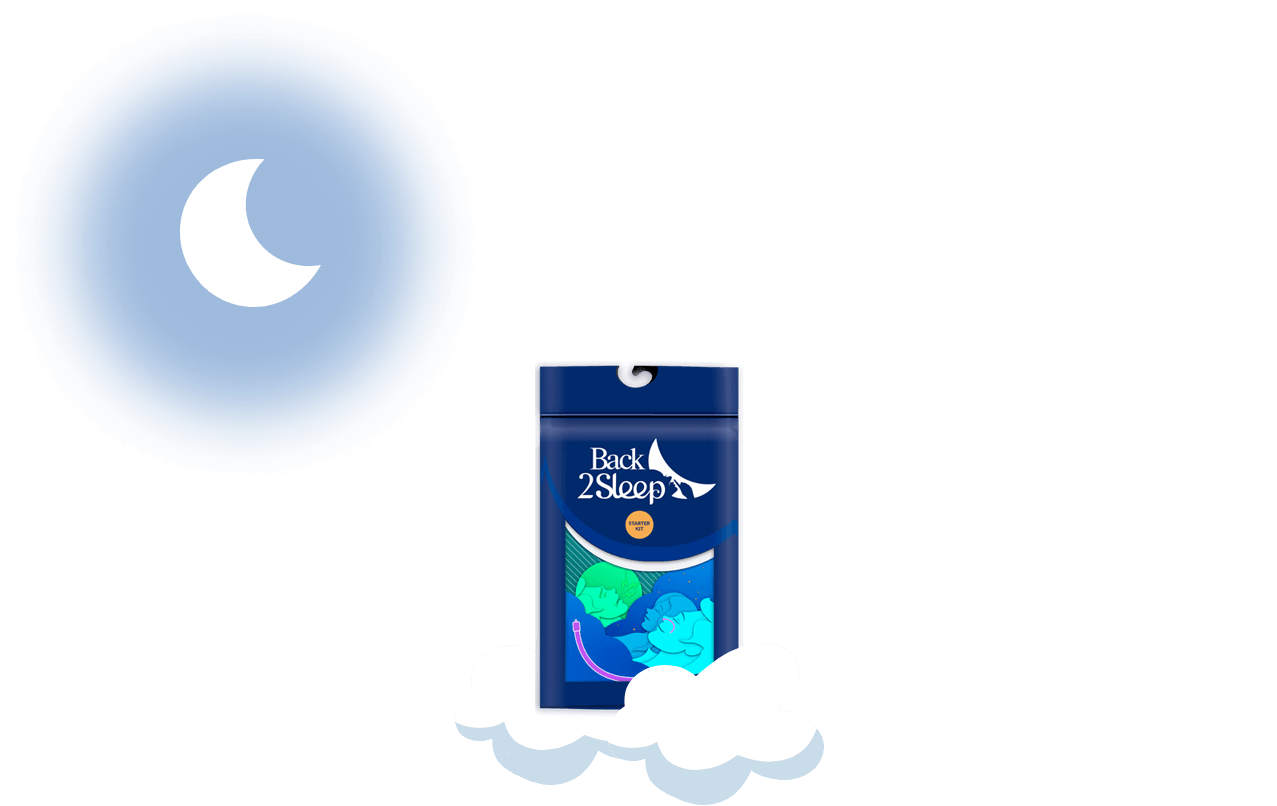
What the evidence says about a nasal stent for short sleep blocks
An internal nasal stent is a soft silicone tube placed inside the nasal passage to hold the airway open during sleep. Back2Sleep makes a CE-certified Class I nasal stent, available without a prescription, with four sizes in the starter kit and no electricity, noise or tubing involved. That profile is why the category suits a nap in a depot bunk.
The device-class evidence comes with limits. A 2021 prospective single-arm pilot published in Respiration (Karger) tested nasal airway stent therapy in mild-to-moderate OSAS with an AHI of 5-20. Among the 32 patients who completed it, mean AHI fell from 12.7 to 8.6 events per hour at one month. Time spent snoring above 50 decibels dropped from 21.8% to 13.2% (p=0.048).
Those results are real but partial. Only 25% reached a complete response with an AHI under 5, 10.5% had a partial response, and about 30% discontinued because of intolerance. This was a single-arm pilot of the device category, not a randomised trial of a particular product. Read it as a comfort-dependent option for snoring and mild-to-moderate OSA, never as a treatment for severe or central apnoea, and never as a CPAP replacement.
Fit also depends on your anatomy. Nasal congestion, a deviated septum or turbinate hypertrophy can make any nasal device uncomfortable. Snoring driven by soft palate and oropharyngeal collapse, or associated with a high Mallampati score, tends to respond better to oral or airway-pressure approaches.
- Pilot data show a partial AHI reduction and lower snoring loudness in decibels, not a cure.
- Roughly 30% of pilot participants stopped because of intolerance.
- Nasal-origin obstruction responds best, palatal collapse may not.
The European driving licence trap nobody warns shift drivers about
A moderate-to-severe OSA diagnosis directly affects your right to drive in the EU. Commission Directive 2014/85/EU (2014), amending Directive 2006/126/EC, Annex III, states that drivers with moderate OSA (AHI 15-29) or severe OSA (AHI 30 or above) accompanied by excessive daytime sleepiness must not drive until effectively treated. Medical review then follows at least every three years for Group 1 drivers (cars, motorcycles) and every year for Group 2 drivers (lorries, buses).
National implementation diverges sharply. A 2025 European Respiratory Journal survey found 25 of 27 member states responded and all had transposed the directive, but only 63% applied it largely unchanged. Greece and Bulgaria use a stricter AHI threshold of 5, France additionally requires a Maintenance of Wakefulness Test (MWT), and 37% impose a waiting period of two weeks to two months before driving resumes.
Here is the trap. The same survey found 32% of countries set a minimum treatment-compliance threshold, typically at least four hours per night on at least 70% of nights, which the directive itself does not require. A rotating-shift driver sleeping a 4-hour post-shift block plus a 90-minute nap can be clinically well controlled and still fail the compliance download the licensing authority actually reads.
Sleepiness at the wheel is not abstract. A 2001 study in the American Journal of Respiratory and Critical Care Medicine followed 2,009 Swedish men for ten years. Those reporting both snoring and excessive daytime sleepiness had an adjusted odds ratio of 2.2 (95% CI 1.3-3.8) for occupational accidents. Drowsy driving and microsleep are the mechanisms clinicians worry about most.
- Group 2 drivers face annual review under EU rules, Group 1 at most every three years.
- Roughly a third of EU countries also demand a documented adherence record.
- Fragmented shift sleep can fail that record even when your AHI is controlled.
The free health assessment most European night workers never claim
EU night workers are entitled to a free health assessment. The Working Time Directive (2003/88/EC) defines a night worker as someone working at least three hours of their shift within a night period of at least seven hours that includes midnight to 05:00, or who regularly works nights across the year. That legal definition, not a self-description, unlocks the entitlement.
It must be offered before you start night work and at regular intervals afterwards, with medical confidentiality protected. It is the cheapest route to getting snoring and excessive daytime sleepiness (EDS) investigated. Screening usually starts with an Epworth Sleepiness Scale (ESS) score, then a home sleep apnoea test or polygraphie ventilatoire, escalating to polysomnography with oxygen desaturation index (ODI) reporting where needed.
The same directive caps night work at an average of eight hours per 24 hours over a nationally set reference period. Where the work involves special hazards or heavy strain, that cap applies to every 24-hour period, with no averaging.
Now the honest part. Article 9 also obliges employers, where possible, to transfer a night worker to suitable day work if health problems connected to night work appear. Many workers read that as a threat to their shift premium and under-report sleepiness to occupational health, médecine du travail or the Betriebsarzt. European respiratory research flags that professional Group 2 drivers under-report most of all.
- The night-worker health assessment is free and statutory across the EU.
- It is a practical route to screening for snoring, sleepiness and possible apnoea.
- Medical confidentiality applies, which is worth knowing before you decide to stay silent.
Hygiene when you sleep twice in 24 hours
Sleeping twice a day means no device gets a full drying cycle. A CPAP humidifier chamber refilled at 08:00 and used again at 16:00 stays damp all day, and damp surfaces are where biofilm and odour develop. Tubing that never dries fully faces the same issue.
Oral appliances have a different problem. A mandibular advancement device worn twice in 24 hours needs cleaning between uses, not once a day. Silicone nasal devices tolerate humidity better, but doubling the use cycles brings forward the point at which a replacement interval written for one sleep per day runs out.
- Two sleeps a day roughly doubles the cleaning burden.
- Damp humidifier chambers and tubing are the highest-risk components.
- Rotating two units solves most of the drying problem cheaply.
A staged plan for the September return to nights
Your first three weeks back on nights are not your steady state, so do not judge a device by them. Circadian misalignment peaks while you re-entrain, and sleep will be shorter and more broken than in October.
1Week one, protect the main block
Use your most effective prescribed therapy for the post-shift sleep. Add blackout blinds, keep the room cool, and use bright light therapy at the start of your shift rather than the end.
2Week two, add the nap deliberately
Introduce a planned pre-shift nap with a fast-fitting device. Ending it at least two hours before your shift limits sleep inertia at handover.
3Week three, review and titrate
If you use a MAD, book the device titration appointment now, not during the transition. If sleepiness persists, ask occupational health about an Epworth score and a home sleep apnoea test.
4Ongoing, plan for sleeping away from home
On-call rooms, depot bunks and cabs have no mains power, no water and no privacy. Decide in advance which device travels with you, and keep it silent for colleagues nearby. Our guide to managing sleep apnoea away from home without CPAP covers the same constraints.
- Expect the worst sleep in weeks one to three, then reassess.
- Lean on speed and portability while re-entraining, on efficacy once settled.

What Back2Sleep Users Say
Frequently Asked Questions
Can you use a CPAP machine when you sleep during the day?
Yes. CPAP works the same way regardless of the clock, so if you have been prescribed it you should use it for every sleep block, including daytime sleep. The practical barriers are set-up time, mains power and noise rather than effectiveness. For very short naps, discuss alternatives with your sleep clinician instead of skipping therapy entirely.
Does sleeping during the day make sleep apnoea worse?
Daytime sleep does not change your airway anatomy, so it does not by itself create sleep apnoea. It does tend to be shorter and more fragmented, because you are sleeping out of phase with your body clock. The practical risk is treatment gaps: skipping your device for a nap leaves those events untreated.
What is the best anti-snoring device for short naps?
For naps under an hour, the practical winner is whichever effective device you can fit in seconds without power or water. That usually means an oral appliance, a nasal stent or a positional aid rather than CPAP. Set-up time matters because a multi-minute routine consumes a large share of a 30-45 minute nap opportunity.
Why do I snore more when I sleep in the morning after a night shift?
Morning sleep after a night shift runs against your circadian rhythm, so it is often shorter and more fragmented, and you usually start it heavily sleep-deprived. Upper airway muscle tone falls during sleep, and nasal congestion is often worse after a long shift. Together these can make snoring sound louder than at night.
Can I lose my HGV or bus licence if I am diagnosed with sleep apnoea?
Under Commission Directive 2014/85/EU, drivers with moderate OSA (AHI 15-29) or severe OSA (AHI 30 or above) plus excessive daytime sleepiness must not drive until effectively treated. Group 2 licences require medical review at least yearly. Once treatment is effective, driving can normally resume under your national rules, so early diagnosis usually protects a licence.
Can I use an anti-snoring device for only 4 hours a night and still get the benefit?
Clinically you get benefit for the hours you actually use it, so four hours is better than none. The complication is regulatory. A 2025 European Respiratory Journal survey found 32% of EU countries require documented compliance, typically four hours per night on 70% of nights, which fragmented shift sleep can fail.
Is a mouthguard or a nasal device better for shift workers?
It depends where your obstruction sits. Nasal devices help when congestion, a deviated septum or turbinate hypertrophy restricts nasal airflow. Mandibular advancement devices help when the tongue base or soft palate collapses. Both fit in seconds, which suits shift patterns, but a mandibular device needs professional titration first, so plan that outside your roster transition.
Do I have to tell my employer I have sleep apnoea?
Rules vary by country and role. EU night workers are entitled to a free health assessment under Working Time Directive 2003/88/EC, with medical confidentiality protected. For professional drivers, the decisive authority is the national licensing body rather than the employer, and those rules differ across the EU. Ask the assessing clinician what is shared.
Ready for quieter nights? Discover the Back2Sleep starter kit and find the right fit for you.
Not sure if you are at risk? Take our sleep risk screening to find out in just a few minutes.
Want to learn how it works? Explore the Back2Sleep nasal stent designed for comfortable, effective relief.