
Palatal Implants and Injection Snoreplasty Compared With a Nightly Airway Device for Palate-Driven Snoring

How palatal implants for snoring and injection snoreplasty stack up against a device you simply wear at night
Two irreversible palate procedures, one reversible nightly device, and the NICE wording, relapse rates and European costs that the ranking guides leave out.
Palatal Implants for Snoring, Injection Snoreplasty and a Nightly Device at a Glance
Palatal implants for snoring stiffen the soft palate with three small braided polyethylene terephthalate (PET) implants. Injection snoreplasty does the same job chemically, with a sclerosant that scars the tissue. Both are permanent. Neither can be undone if the palate turns out not to be your main problem. A nightly airway device changes no anatomy at all, which is both its weakness and its quiet advantage.
You are here because an ENT looked at your velopharynx, the retropalatal segment behind the soft palate, and said the noise starts there. That finding deserves scrutiny first, so it helps to know how confidently a clinician can pin down the vibrating site in your airway. What follows is the evidence, including the parts clinic brochures leave out.
- Palatal implants for snoring and injection snoreplasty stiffen the same tissue permanently, and only the method differs.
- A reversible device acts on the same segment without leaving scar tissue.

What Each Palatal Stiffening Procedure Does to Your Soft Palate
Every palatal stiffening procedure shares one mechanism. Make floppy tissue less floppy and it stops fluttering. They differ in method, discomfort and evidence.
Soft-palate implants
Three braided PET strips go into the muscular layer of the soft palate under local anaesthetic, in one outpatient appointment. Scar tissue forms around each strip over the following weeks, and that scar is the stiffening. In 30 patients followed for 12 months, snoring frequency fell from 6.9 to 5.0 and loudness from 9.2 to 5.9, with Epworth Sleepiness Scale scores dropping from 7.4 to 5.6 (Khasawneh and colleagues, Future Science OA, 2021).
Implant extrusion is the risk consumer pages name without measuring. In that same series the partial extrusion rate was 6.7% at 12 months, so roughly one patient in fifteen had an implant work its way back out through the palatal mucosa. Ask your surgeon what happens if one extrudes.
Injection snoreplasty
A sclerosant is injected into the submucosa of the soft palate. Published European series used an ethanol sclerosant at 50 to 75%, or 2 ml of sodium tetradecyl sulfate at 1% or 3% (Olszewska and colleagues, Otolaryngologia Polska, 2014). The injection deliberately creates a mucosal ulcer, and that ulcer heals into a stiffer, scarred palate. Hence the other name, sclerotherapy of the soft palate. Published series describe roughly half of patients returning for a second injection at six to eight weeks. The uvula and palate stay sore for days.
Sodium tetradecyl sulfate is licensed in Europe as a varicose-vein sclerosant, so injecting it into the soft palate is off-label use of a licensed medicine rather than an approved device. That is a prescriber decision under national rules, and a fair question to ask.
Radiofrequency ablation of the soft palate
Heat lesions from a needle electrode shrink and stiffen the palate over the following weeks, a technique also called somnoplasty. A separate guide covers what a radiofrequency session involves and who it suits. In the one published trial putting two of these techniques directly against each other, 70 patients with simple snoring were treated: 87.5% were satisfied after controlled-temperature radiofrequency against 76.7% after injection snoreplasty, with similar discomfort in both groups (Iseri and Balcioglu, Otolaryngology-Head and Neck Surgery, 2005).
| Approach | How the palate is changed | Published result | Reversible | European status |
|---|---|---|---|---|
| Soft-palate implants | Three braided PET implants, local anaesthetic | Frequency 6.9 to 5.0, loudness 9.2 to 5.9 at 12 months, with 6.7% extrusion (Khasawneh, 2021) | No | NICE HTG154, 2007: research use only for simple snoring |
| Injection snoreplasty | Sclerosant creates an ulcer that heals as scar | 92% success falling to 75% by 19 months, 18% relapse (Brietzke & Mair, 2003) | No | No NICE guidance, only off-label use of a licensed sclerosant |
| Radiofrequency ablation of the soft palate | Heat lesions shrink and stiffen tissue | 87.5% satisfied against 76.7% for snoreplasty (Iseri & Balcioglu, 2005) | No | Separate NICE lineage, IPG124 in 2003 through to HTG327 |
| Palatal surgery: UPPP, anterior palatoplasty, barbed reposition pharyngoplasty | Tissue removed or repositioned | Pooled snoring VAS 7.29 to 3.50, 18 studies, 716 patients (Cammaroto, 2025) | No | Cochrane: not recommended ahead of positive airways pressure |
| Nightly nasopharyngeal stent | Splints the airway open, and nothing is altered | AHI reduced in anteroposterior palatal collapse, with no effect on retrolingual or multilevel (Dellweg, 2022) | Yes | CE-marked device class, no prescription |
- The one direct comparison slightly favours radiofrequency over snoreplasty on patient satisfaction.
- Snoreplasty is rarely a single appointment, so budget for a second session.
What Most Guides on Palatal Implants for Snoring Leave Out
Two things are missing from nearly every page ranking for palatal implants for snoring: the regulatory verdict, and what happens after the first year.
Flaw one, implants presented as a routine orderable option
They are not, at least not in the United Kingdom. NICE guidance HTG154, formerly interventional procedures guidance IPG240, states that the evidence on efficacy "is based on small case series only and there is a lack of well-controlled and comparative data. Therefore, this procedure should only be used in the context of research" (NICE, 2007). Its companion guidance HTG155 finds "inadequate evidence that the procedure is efficacious" for obstructive sleep apnoea (NICE, 2007). No NICE guidance exists for injection snoreplasty at all.
Availability is the second surprise. A leading sleep-surgery reference site states that the branded implant procedure is not currently available because the implants are no longer manufactured. Treat that as a single source worth checking, not settled fact. No consumer page tells you to ask.
Flaw two, results described as if they were permanent
Long-term data says otherwise. When the original snoreplasty cohort was followed to a mean of 19 months, subjective success fell from 92% to 75%, with an 18% snoring relapse rate (Brietzke and Mair, Otolaryngology-Head and Neck Surgery, 2003). The 2025 systematic review in the Journal of Clinical Medicine pooled 43 studies and 2,713 patients and stated that most studies report only mid-term follow-up of six to twelve months, giving no perspective on the stability of results. It judged most studies to carry serious or critical risk of bias (Cammaroto and colleagues, 2025).
Then the placebo problem. A double-blind randomised trial at University Medical Centre Mannheim treated 22 patients with mild to moderate obstructive sleep apnoea. The apnoea-hypopnoea index, hypopnoea index and lowest oxygen saturation improved within the treatment group, yet there was no statistical difference against the placebo group (Maurer and colleagues, European Archives of Oto-Rhino-Laryngology, 2012). A Cochrane review of 12 randomised trials and 709 participants concluded that surgery cannot be recommended as a front line therapy ahead of positive airways pressure. The peer-reviewed paper ranking near the top of this search, meanwhile, is a case report of one 56-year-old man followed for two months (Choi and colleagues, Clinical and Experimental Otorhinolaryngology, 2014).
- NICE restricts soft-palate implants for simple snoring to research settings, and calls the apnoea evidence inadequate.
- Snoreplasty loses roughly a fifth of its effect within two years.
- The strongest European trial of implants did not beat placebo.
How Your ENT Decided the Palate Is the Vibrating Site
The palate diagnosis is only as good as the test behind it, and two tests do most of that work.
The Muller manoeuvre asks you to inhale against a closed nose and mouth while a scope watches the airway collapse. Quick, cheap, and awake, which is the problem: your muscle tone at 3am is nothing like it is in the chair. Drug-induced sleep endoscopy, or DISE, sedates you into something closer to sleep and grades the airway with the VOTE classification, scoring velum, oropharynx, tongue base and epiglottis separately.
That distinction decides everything. Anteroposterior palatal collapse, the palate flapping front to back, is what palatal stiffening targets and what drives classic palatal flutter snoring. Lateral pharyngeal wall collapse and tongue-base collapse are different mechanical problems, and stiffening the palate does little for either. Most published palate results come from patients never phenotyped this way: fewer than half the studies in the 2025 review's quantitative analysis used DISE at all.
- A Muller manoeuvre alone is weak evidence that your palate is the culprit.
- DISE with VOTE scoring separates anteroposterior palatal collapse from lateral wall and tongue-base patterns, and stiffening the wrong level cannot be undone.

Where a Reversible Nightly Device Fits Against Palatal Implants for Snoring
A nightly device works the other way round. Rather than stiffening the palate, it holds the segment open so there is less for the tissue to flutter against.
A Swiss study at Kantonsspital Baselland tested a nasopharyngeal stent in 122 patients with sleep-related breathing disorders, 101 of them analysable. Cross-referenced against sleep endoscopy, the stent significantly reduced the apnoea-hypopnoea index in patients with palatal obstruction, mainly anteroposterior collapse, and did not influence retrolingual or multilevel obstruction. Using a 40% AHI reduction as the cut-off, 85.7% of soft palate obstructions were detected compared with DISE (Dellweg, Kampmann and Tschopp, The Journal of International Medical Research, 2022). That is the same segment palatal implants for snoring aim to stiffen, approached without scarring.
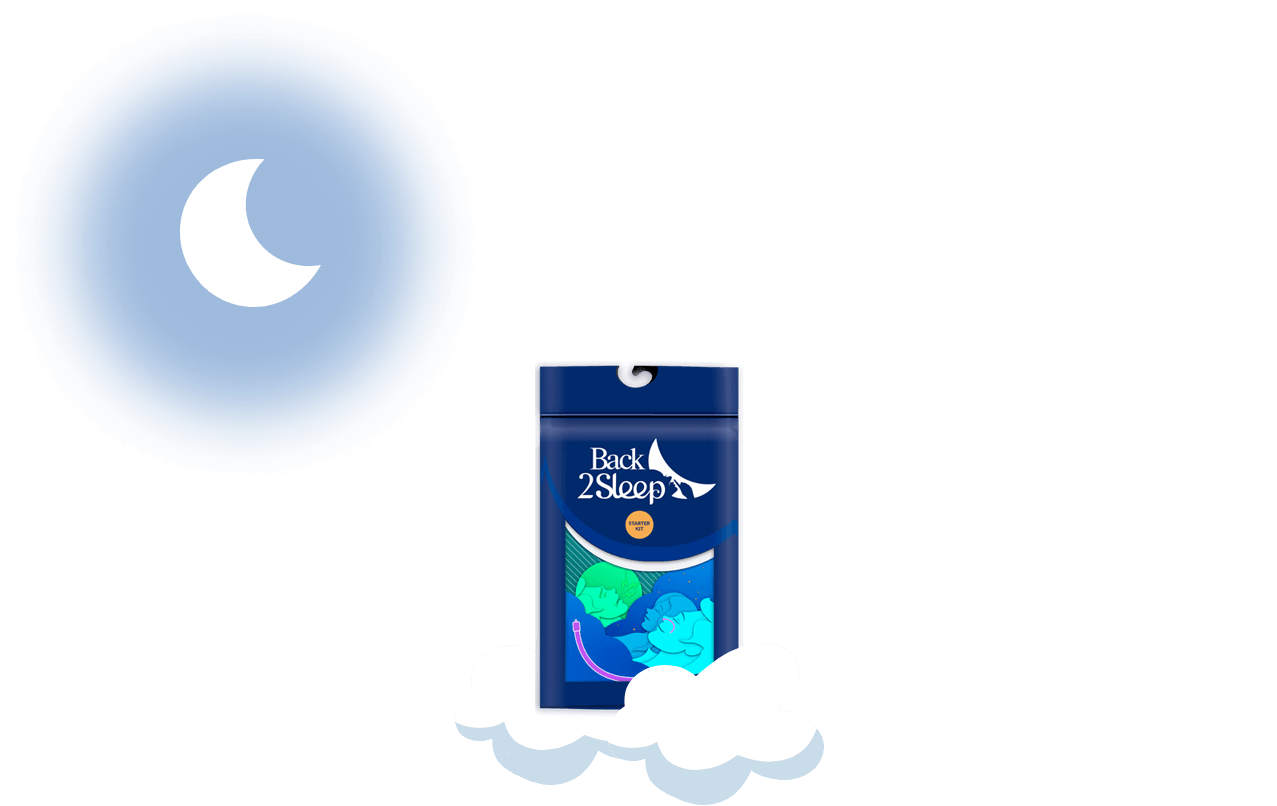
That study did not test Back2Sleep, but it tested the same device class placed by the same route. Back2Sleep is a CE-certified Class I soft silicone nasopharyngeal stent from a French company in Paris, passed through the nostril to sit behind the soft palate and keep the nasal airway open during sleep. No electricity, no noise, no tubing, no prescription, and a starter kit of four sizes at around EUR 44.90. It is for snoring and mild to moderate obstructive sleep apnoea, never severe disease, and it does not replace prescribed positive airway pressure.
The honest limitations
Tolerance is the real constraint. In that Swiss cohort, 14 of 122 patients were excluded because they could not tolerate the stent, roughly one in nine, and the authors concluded that a stent of this class is not readily tolerated. It is also not a nasal dilator or an adhesive strip. A 2026 meta-analysis in Cureus covering 17 studies and 496 participants found no significant difference in AHI or snoring index with nasal dilators, and concluded they cannot be recommended as monotherapy. Different level of the airway, different job.
The asymmetry is the whole point. A device that fails costs you a few weeks and a small sum. A scarred palate that fails is permanent, and stays permanent if the real problem was the lateral wall all along.
- A nasopharyngeal stent acts on the palatal segment reversibly and can double as a same-night test of the diagnosis.
- Roughly one in nine people in the Swiss study could not tolerate a stent.
What This Costs in Europe, and What Anyone Reimburses
Almost nothing, for simple snoring. That is the short answer across most of Europe, and the widest gap between American consumer pages and your reality.
In the United Kingdom, published private quotes include around GBP 1,000 for palatal implants for snoring at a clinic and GBP 2,695 for a full private snoring-surgery package with consultations and endoscopic assessment. NHS funding for a procedure NICE limits to research settings is unlikely. In France, Assurance Maladie reimburses an orthèse d'avancée mandibulaire, the mandibular advancement device, only for diagnosed obstructive sleep apnoea, first line for moderate disease at an IAH of 15 to 30 per hour, and only with entente préalable from your caisse. Isolated snoring without apnoea attracts essentially nothing, procedure or device.
The vocabulary problem
The same condition carries different names across Europe, which makes comparing quotes harder. Simple snoring in UK usage matches the international term isolated snoring, the French ronchopathie or ronflement isole, and the German primares Schnarchen. The apnoea-hypopnoea index is written AHI in English and IAH in French. Palatal implants appear on French clinic sites as implants palatins.
- For isolated snoring you pay out of pocket across most of Europe.
- French mandibular device reimbursement starts at a diagnosed IAH of 15 to 30 per hour, with prior agreement.
A Four-Step Plan Before You Book Any Palatal Procedure
The most recent framework for your situation is European. An international consensus on isolated snoring, published in the European Annals of Otorhinolaryngology, Head and Neck Diseases in 2026, ran a two-round Delphi with 35 experts from 16 countries, and 44 of 58 statements reached agreement at a 75% threshold. Severity should be graded on snoring frequency, your bed partner's complaint and the couple's quality of life rather than acoustic measurement alone. Nasal obstruction is a treatable comorbidity that may be assessed first.
1Confirm the level, not just the impression
Ask whether your diagnosis came from a Muller manoeuvre or from sleep endoscopy, and whether the report names anteroposterior collapse. If lateral pharyngeal wall collapse is present too, palatal stiffening alone is a weaker bet.
2Clear the nose first
A deviated septum or turbinate hypertrophy raises the pressure swing that makes the palate flutter. The 2026 consensus supports assessing nasal obstruction alongside snoring management, and a nose is cheaper to treat.
3Run a two to four week reversible trial
Wear a nightly device and have your bed partner score the noise each morning on a snoring visual analogue scale of zero to ten. Clear improvement supports the palatal diagnosis. No change is information you want before scarring tissue, not after.
4Reassess at three to six months
The consensus recommends reassessment at three to six months using quality-of-life metrics or smartphone recordings. Apply that to a procedure too, and agree in advance what counts as failure.
If you still want a procedure, take these four questions with you.
- Can you obtain the implants, and when did you last place a set?
- Did my sleep endoscopy show anteroposterior collapse, or was the lateral wall involved?
- What is your relapse rate beyond twelve months, in your own patients?
- What is the total out-of-pocket cost, including follow-up?
Palatal implants for snoring, snoreplasty and radiofrequency sit on the same ladder as heavier surgery, from laser-assisted uvulopalatoplasty (LAUP) to uvulopalatopharyngoplasty (UPPP). For someone whose main complaint is bed partner sleep disruption, and for whom positive airway pressure was never indicated or was abandoned through CPAP intolerance, the reversible option deserves the first trial.
- Confirm the collapse pattern, clear the nose, then trial something reversible before anything permanent.
- Judge the result the way the 2026 European consensus does, on your bed partner's experience.
What Back2Sleep Users Say
Which Back2Sleep is right for you?
SnoreKit
The 4 sizes (S, M, L, XL) and 3 lubricants, to find the stent that fits you.
€44.90
Start with the SnoreKit
Single-size box
1 stent in your size and 3 lubricants, to keep going.
€34.00
Choose my size- CE-marked medical device
- Designed in France, made in Germany
- Free delivery in continental Europe
Not sure your snoring is harmless? Take the sleep risk screening.
Frequently Asked Questions
Do palatal implants actually stop snoring, or just reduce it?
They reduce it rather than stop it. In 30 patients followed for 12 months, snoring frequency fell from 6.9 to 5.0 and loudness from 9.2 to 5.9, with Epworth scores dropping from 7.4 to 5.6 (Khasawneh, Future Science OA, 2021). NICE stated in 2007 that soft-palate implants for simple snoring should be used only in research.
How long do palatal implants last before the snoring comes back?
Long-term data is thin. The 2025 systematic review in the Journal of Clinical Medicine noted that most studies stop at six to twelve months, giving no view of stability over time. For injection snoreplasty, success fell from 92% to 75% by a mean of 19 months, with 18% relapsing (Brietzke and Mair, 2003).
Are soft-palate implants still available in Europe?
Ask the clinic before paying anything. A leading sleep-surgery reference site states that the branded implant procedure is not currently available because the implants are no longer manufactured, while consumer pages still quote prices around GBP 1,000. NICE guidance from 2007 also restricts the procedure for simple snoring to research settings in the UK.
Does injection snoreplasty hurt, and how many injections will I need?
Expect soreness, and expect more than one visit. The sclerosant, usually 50 to 75% ethanol or sodium tetradecyl sulfate at 1% or 3%, deliberately creates a mucosal ulcer that heals as scar tissue (Olszewska and colleagues, Otolaryngologia Polska, 2014). Published series describe roughly half of patients returning at six to eight weeks for a second injection.
Palatal implants, radiofrequency or snoreplasty, which works best for soft palate snoring?
Only one trial compares two of them directly. In 70 patients with simple snoring, 87.5% were satisfied after controlled-temperature radiofrequency against 76.7% after injection snoreplasty, with similar discomfort in both groups (Iseri and Balcioglu, Otolaryngology-Head and Neck Surgery, 2005). No trial in this evidence base pits implants against either technique, so decide on reversibility, cost and your endoscopy result.
Can palatal implants fall out or come through the palate?
Partial extrusion happens. In 30 patients followed for 12 months, the partial implant extrusion rate was 6.7%, meaning an implant began working its way back out through the mucosa in roughly one case in fifteen (Khasawneh, Future Science OA, 2021). Ask your surgeon how they handle it and how often they see it.
Is snoring surgery reimbursed by the NHS or in France?
Rarely, for isolated snoring. NICE limits soft-palate implants for simple snoring to research, so NHS funding is unlikely. In France, Assurance Maladie reimburses a mandibular advancement device only for diagnosed sleep apnoea, first line at an IAH of 15 to 30 per hour, with entente préalable. Isolated snoring attracts essentially nothing.
Can a home sleep apnoea test tell me whether my soft palate is the problem?
No. A home sleep apnoea test counts breathing events, but it does not show where the airway collapses. Only drug-induced sleep endoscopy grades the level and pattern, such as anteroposterior palatal collapse versus lateral pharyngeal wall collapse. A reversible nightly device trial gives a practical clue while you wait for that assessment.
4 sizes, €44.90See it