
Treating Congestion-Driven Snoring With a Steroid Nasal Spray or With a Mechanical Airway Device

How a steroid nasal spray for snoring compares with a device that holds your nose open
Two European trials tested the spray directly and found it opens the nose without quietening the snore, which changes what you should reach for tonight.
What a steroid nasal spray for snoring actually changes
A steroid nasal spray for snoring opens a blocked nose reliably. It does not reliably quieten the snore. Two European trials tested exactly that. In a randomised placebo-controlled crossover trial of 23 snorers with rhinitis at St Vincent's University Hospital in Dublin, intranasal fluticasone cut the median apnoea-hypopnoea index (AHI, the number of breathing pauses per hour of sleep) from 20.0 on placebo to 11.9 and lowered nasal airway resistance, while recorded snoring noise stayed unchanged (Kiely and colleagues, Thorax, 2004). At Linkoping University in Sweden, three months of mometasone furoate 200 microgram in 84 snorers produced no fall in mean snoring score, though daytime sleepiness improved slightly and partners reported less disturbance (Hultcrantz and colleagues, Acta Otolaryngologica, 2010).
Nose and noise are separate targets. Congestion is still a real part of the problem. In 4,916 adults in the Wisconsin Sleep Cohort, chronic severe nocturnal nasal congestion carried an adjusted odds ratio of 3.0 for habitual snoring, rising to 4.9 where it persisted at five-year follow-up (Young and colleagues, Archives of Internal Medicine, 2001). If seasonal congestion is what wrecks your sleep, an intranasal corticosteroid is worth trying. Try it knowing what it treats: swollen mucosa, not vibrating tissue.
- A nasal steroid treats mucosal swelling, which improves airflow and can lower AHI.
- Both adult trials of nasal steroids for snoring found the noise itself unchanged.
- Nightly congestion roughly triples the odds of habitual snoring, so treating it still pays.
Two things nearly every guide to a steroid nasal spray for snoring gets wrong
The first error is a misread trial. Page after page cites a paediatric study as proof that sprays stop snoring. In 276 children aged 3 to 12 with sleep-disordered breathing, intranasal mometasone resolved significant symptoms in 44% versus 41% for intranasal saline, a risk difference of 4% with a confidence interval running from minus 8% to plus 16% and a P value of .51 (Baker and colleagues, MIST randomised clinical trial, JAMA Pediatrics, 2023). That is a null result. Paediatric sleep-disordered breathing, in which adenoid hypertrophy commonly contributes, is also a different problem from adult snoring.
The second error is geographic. Almost every top-ranking article lists American pharmacy products and never compares the drug against a physical device. Several of those products are not dispensed in European pharmacies at all. The drug-versus-device question has published numbers on both sides. Nobody puts them in the same place.
- The most-quoted trial in this topic was negative, not positive.
- Findings in children do not transfer to adult snorers.
- No mainstream guide compares a corticosteroid against a mechanical airway device on evidence.
Find out in thirty seconds whether your blockage is steroid-responsive
A corticosteroid shrinks inflamed tissue. It cannot widen a structurally narrow nose. Inferior turbinate hypertrophy, allergic rhinitis, perennial rhinitis, non-allergic vasomotor rhinitis and chronic rhinosinusitis with nasal polyps all involve swelling, so a spray has something to act on. Nasal valve collapse, a deviated nasal septum and a narrow vestibule are shape problems, and no anti-inflammatory changes shape. Two bedside tests separate them before you commit weeks to a daily medicine.
1The Cottle manoeuvre
Place a fingertip on the cheek beside your nose and pull the skin gently outwards. Breathe in. If airflow improves sharply, the Cottle manoeuvre is positive and your obstruction sits at the nasal valve. That is a mechanical finding, and a spray will disappoint you.
2The one-night device test
Sleep one night with an internal nasal dilator or an external nasal dilator strip. Better breathing on night one tells you the obstruction is mechanical and responds to being physically held open. Read more on why a collapsing nasal valve is so often missed.
3The pattern check
Blocked only in pollen season points to allergy. Blocked every night, all year, with clear mucus and no itch points to non-allergic rhinitis. Blocked only when you lie down, and only on the lower side, is usually venous pooling in the turbinates.
Clinics measure the same thing objectively. Rhinomanometry and acoustic rhinometry quantify nasal airway resistance, peak nasal inspiratory flow (PNIF) records how hard you can sniff in, and the NOSE scale (Nasal Obstruction Symptom Evaluation) scores how blocked you feel. They tell you how narrow the nose is, not where the vibration comes from.
- Swelling responds to a corticosteroid, but a collapsing valve or bent septum does not.
- A positive Cottle manoeuvre points you to a device, not a drug.
- Test first and you avoid weeks of medication that was never going to work.
Spray versus device, with real numbers on both sides
Anyone weighing a steroid nasal spray for snoring against a physical device deserves the comparison this topic leaves out. Every figure below comes from a published trial.
| What you are comparing | Intranasal corticosteroid | Mechanical nasal device |
|---|---|---|
| Acts on | Inflamed mucosa and swollen inferior turbinates | The nasal valve and vestibule, held open physically |
| Time to first effect | Maximum benefit may need 3 to 4 days, with full mucosal effect commonly quoted at 1 to 2 weeks | The first night you wear it |
| Nasal airway resistance | Fell from 3.27 to 2.74 on fluticasone (Thorax, 2004) | Median resistance in sleep 39.1% lower with a dilator strip (Wheatley, Advances in Therapy, 2019) |
| Breathing events | Median AHI 20.0 to 11.9 (Thorax, 2004), and AHI 30.3 to 23.3 in patients with allergic rhinitis (Cochrane, 2013) | Respiratory event index (REI) 22.4 to 15.7 and lowest SpO2 81.9% to 86.6% with a silicone nasopharyngeal airway stent (Okuno, Journal of Oral Rehabilitation, 2019) |
| Snoring sound | Unchanged in both adult trials (2004 and 2010) | Not measured, though spontaneous arousal rate fell about 37% with a dilator strip (2019) |
| EU access | Pharmacy or prescription depending on country, adults only, licensed for allergic rhinitis | Class I medical device under Regulation (EU) 2017/745, no prescription |
| Main drawback | Epistaxis listed as Very common on the UK over-the-counter label, and duration caps apply | Needs correct sizing and a few nights of getting used to it |
| Suits you if | Your nose is swollen, itchy or seasonal | Your nose is narrow or collapses on inspiration |
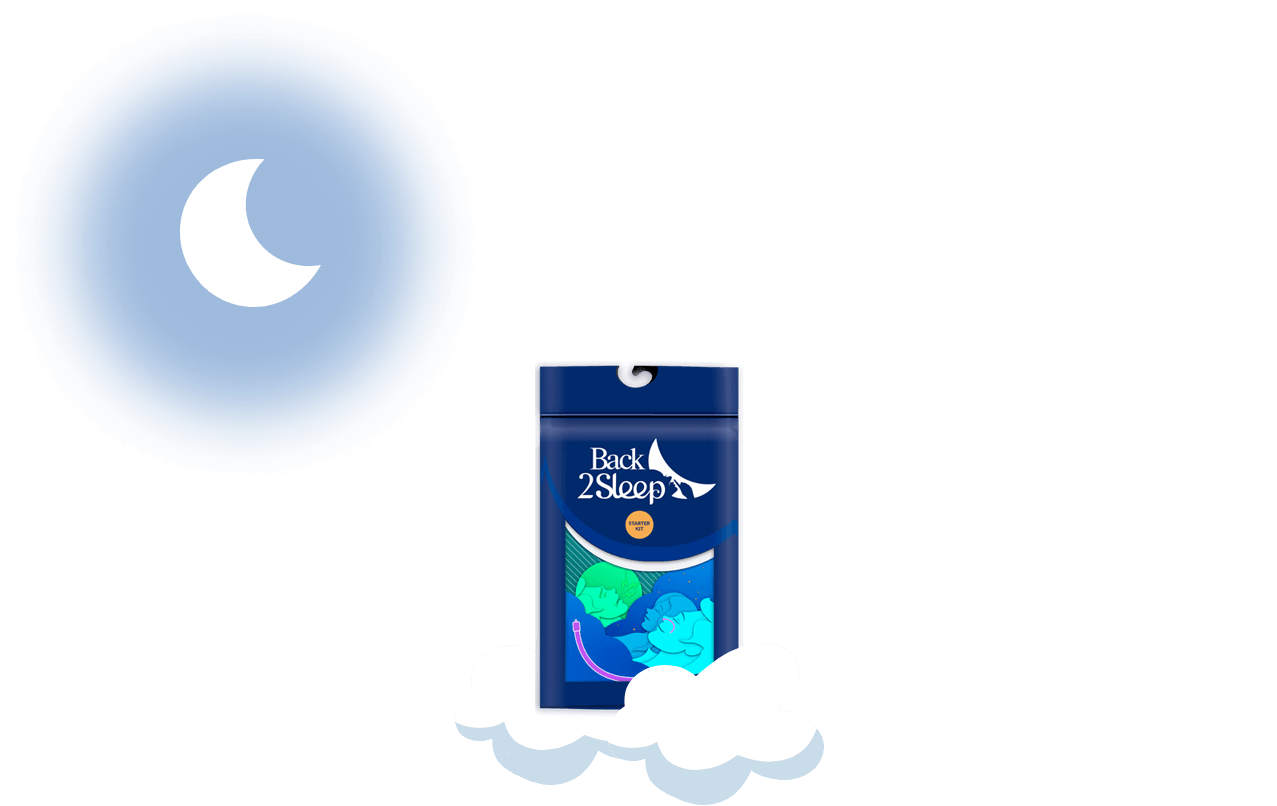
Back2Sleep sits in the right-hand column. It is a soft silicone intranasal stent that keeps the nasal airway open during sleep, CE-certified as a Class I device, sold without a prescription in a starter kit of four sizes, with no electricity, no noise and no tubing. Two limits belong here. The stent figures above come from a comparable silicone nasopharyngeal airway stent studied in Japan, not from Back2Sleep, so read them as category evidence rather than brand proof. The indication is snoring plus mild-to-moderate obstructive sleep apnoea. Severe obstructive sleep apnoea belongs on CPAP, and neither a spray nor a stent replaces it.
- The drug wins on inflammation and on measurable AHI reduction in patients with rhinitis.
- The device wins on speed, on structural collapse, and on access.
- Neither reliably reduces the recorded volume of an adult snore.

Side effects, dose caps and the European rules most guides skip
Nosebleeds are the side effect people underestimate. The UK Summary of Product Characteristics for the over-the-counter fluticasone propionate nasal spray classifies epistaxis as Very common, meaning more than 1 in 10 users (UK MHRA-approved labelling, 2024). Nasal septal perforation and, with prolonged high-dose exposure, hypothalamic-pituitary-adrenal (HPA) axis suppression are the recognised long-term cautions for this drug class. That is why labels carry duration limits, and why nightly year-round use is a pharmacist conversation rather than a solo decision.
| Rule | What it actually says |
|---|---|
| Germany, AMVV Anlage 1 | Prescription exemption for intranasal mometasone, fluticasone and beclometasone dipropionate applies to adults only, for seasonal allergic rhinitis, only after a doctor has made the first diagnosis, capped at 200 microgram per day (400 microgram for beclometasone). |
| UK, over-the-counter fluticasone label | General Sales List, adults 18 and over, and not to be used for more than 1 month continuously without consulting a doctor. |
| UK, NHS guidance on mometasone | Usually usable for up to 3 months, and an opened bottle should be discarded after 2 months. |
| EU medical devices, Regulation (EU) 2017/745 | Annex VIII Rule 5 classifies a device used in the nasal cavity as Class I, so a CE-marked nasal stent or dilator needs no prescription and no prior allergy diagnosis. |
| Licensing reality | Neither of those sprays is licensed for snoring, so using one nightly for a blocked nose is off-label self-medication. |
The consequence in Germany is blunt. A year-round nocturnal blocker with no doctor-confirmed seasonal allergy diagnosis sits outside the exemption and needs a Rezept, so a search that starts at Schnarchen and verstopfte Nase nachts ends at a Kortison-Nasenspray the pharmacist cannot simply hand over. In France and much of continental Europe the first contact is the pharmacie, not a GP appointment, so name the real complaint there: ronflement with obstruction nasale, not hay fever. The guidance an EU clinician works from is European too, chiefly EPOS 2020, the European Position Paper on Rhinosinusitis and Nasal Polyps, and NICE in the UK.
European shelves carry one molecule family under many names: fluticasone propionate, fluticasone furoate, mometasone furoate, beclometasone dipropionate, budesonide, triamcinolone acetonide, plus an azelastine-fluticasone combination for people who also need an antihistamine. Which one you get matters far less than whether your obstruction is inflammatory at all.
- Nosebleeds affect more than one in ten users of the UK over-the-counter fluticasone spray.
- German law ties the pharmacy route to a doctor-diagnosed seasonal allergy and a 200 microgram daily cap.
- A CE-marked nasal device faces none of those gates because it is Class I.
A four-week plan with a stop rule
Most people abandon a steroid nasal spray for snoring on night three because nothing has happened yet. Nothing was supposed to have happened yet. Here is a sequence that covers the ramp-up and ends in a decision.
- Nights 1 to 3. Start the spray, aiming the nozzle away from the septum, towards the outer wall of each nostril. Expect no benefit yet. If your Cottle test was positive, wear a nasal dilator or stent on these nights instead of sleeping badly while you wait.
- Days 4 to 7. Maximum benefit can begin around day 3 or 4 in some people. Add an isotonic nasal irrigation before the spray if mucus is thick. Note each morning whether you woke with a dry mouth, which flags nocturnal mouth breathing.
- Weeks 2 to 3. Full mucosal effect is usually described at 1 to 2 weeks. Score your daytime sleepiness with the Epworth Sleepiness Scale (ESS) at week 0 and week 3, and ask your partner about the noise separately.
- Week 4, the stop rule. No improvement in nasal breathing after four weeks means the spray is not your answer. The UK label independently says not to continue past one month without medical advice.
- Escalate. Take the results to a pharmacist or GP, then to an ENT clinic if the blockage is structural, or to a home sleep apnoea test or full polysomnography if the snoring is loud, pauses are witnessed, or sleepiness is high.
The threshold for testing rather than trying another spray is lower than most people assume. Population polysomnography in Lausanne found an AHI of 15 or more per hour in 49.7% of men and 23.4% of women aged 40 to 85 (Heinzer and colleagues, HypnoLaus study, The Lancet Respiratory Medicine, 2015). Habitual snoring was reported by 34.6% of 850 French men aged 22 to 66, with nocturnal nasal obstruction an independent associated factor (Teculescu and colleagues, Revue des Maladies Respiratoires, 2007).
- Give the spray four weeks, not four nights, then stop if the nose has not changed.
- Cover the ramp-up nights with a mechanical device.
- Over 40 with loud snoring and congestion, a sleep test beats a third spray.

When the nose clears and the snoring stays
This outcome is common and almost nobody writes about it. Your nose opens, your partner still elbows you. It means the vibrating tissue was never nasal. A steroid nasal spray for snoring can only fix the nasal half of the problem. Soft palate, uvula or tongue base is producing the noise, and no nasal treatment silences a palatal flutter. The Dublin and Swedish trials measured exactly this gap between patency and volume.
Drug therapy in general has thin support here. A Cochrane review of 30 trials covering 25 drugs in 516 adults concluded there is insufficient evidence to recommend drug therapy for obstructive sleep apnoea (Mason and colleagues, Cochrane Database of Systematic Reviews, 2013). In adults with mild disease, 12 weeks of intranasal fluticasone plus montelukast produced no significant change in AHI, although total sleep time and the share of REM sleep rose (Smith and colleagues, Journal of Clinical Sleep Medicine, 2019).
What is left is mechanical. Positional therapy helps if your sleep study shows most events happen on your back. A mandibular advancement device (MAD) moves the lower jaw forward and targets the tongue base. A nasal stent or dilator addresses the nasal valve. CPAP remains the standard for severe disease, where CPAP mask tolerance is the usual sticking point. Our guide to solutions for a nose that will not breathe walks through the rest in order of effort.
One reason to keep going rather than accept the noise: among 34,727 normotensive French adults in the CONSTANCES cohort, habitual snoring at least three nights a week was reported by 23.6% and was associated with incident treated hypertension, with an adjusted hazard ratio of 1.17 (Balagny and colleagues, Hypertension, 2024). Association is not proof of cause. It is still a reasonable argument for getting a persistent snore assessed.
- An open nose with unchanged noise means the vibration source is palatal or tongue-base.
- Cochrane found insufficient evidence for drug therapy in obstructive sleep apnoea.
- Persistent snoring has been linked to later treated hypertension in a large French cohort.
What Back2Sleep Users Say
Which Back2Sleep is right for you?
SnoreKit
The 4 sizes (S, M, L, XL) and 3 lubricants, to find the stent that fits you.
€44.90
Start with the SnoreKit
Single-size box
1 stent in your size and 3 lubricants, to keep going.
€34.00
Choose my size- CE-marked medical device
- Designed in France, made in Germany
- Free delivery in continental Europe
Not sure your snoring is harmless? Take the sleep risk screening.
Frequently Asked Questions
Does a fluticasone nasal spray actually stop snoring, or just unblock my nose?
It mainly unblocks the nose. In a randomised crossover trial of 23 snorers with rhinitis, fluticasone cut median AHI from 20.0 to 11.9 and lowered nasal airway resistance, yet recorded snoring noise was unchanged (Thorax, 2004). Expect easier breathing through the nose. Do not promise your partner a quieter night on the spray alone.
How long does a steroid nasal spray take to work for a blocked nose at night?
UK labelling for the over-the-counter fluticasone spray states that maximum benefit may require three to four days of continuous treatment in some people, and consumer sources put full mucosal effect at one to two weeks. Use it every night without skipping doses. Judge the result at four weeks, not at four nights.
Can I use a steroid nasal spray every night, long term?
Labels set limits. The UK over-the-counter fluticasone spray says not to use it for more than one month continuously without consulting a doctor, and NHS guidance on mometasone allows up to three months, with an opened bottle discarded after two. Neither product is licensed for snoring, so nightly use is off-label.
Is it safe to use a nasal spray and a nasal dilator or nasal stent at the same time?
They act on different structures, so they can be used together. The spray reduces mucosal swelling over days, while the device holds the nasal valve open from the first night. Use the spray first, then insert the device once it has settled. Ask a pharmacist first if you have had nasal surgery or frequent nosebleeds.
Why does my nose only block up at night when I lie down?
Lying flat increases blood pooling in the nasal turbinates, so tissue that felt clear standing up swells within minutes. Clinicians commonly see this pattern alongside allergic and non-allergic rhinitis. It also explains why the lower nostril blocks first when you turn onto your side, then swaps when you roll over.
Does a steroid nasal spray help sleep apnoea or only snoring?
It can help the apnoea more than the noise. Fluticasone lowered median AHI from 20.0 to 11.9 in snorers with rhinitis (Thorax, 2004), yet a Cochrane review of 30 drug trials in 516 adults found insufficient evidence to recommend drug therapy for obstructive sleep apnoea (2013). Severe apnoea still needs CPAP.
Can a steroid nasal spray cause rebound congestion like a decongestant spray does?
No. Rebound congestion, known as rhinitis medicamentosa, comes from decongestant sprays containing oxymetazoline or xylometazoline used for longer than a short course. Corticosteroid sprays act on inflammation rather than on blood vessels, so they do not cause it. Their trade-off is slower onset and nosebleeds, listed as Very common on the UK label.
What is the best nasal spray for snoring if I do not have allergies?
The over-the-counter sprays in EU and UK pharmacies are licensed for allergic rhinitis, not for snoring, so the cause matters more than the product. Non-allergic vasomotor rhinitis and turbinate swelling can still respond to an intranasal corticosteroid. Saline irrigation is the low-risk start. If a dilator helps on night one, your obstruction is mechanical.
4 sizes, €44.90See it