
Choosing an Anti-Snoring Device When You Wear Dentures or Have Dental Implants

What actually works as an anti-snoring device with dentures, dental implants or no anchor teeth at all
Dentures, implants and bare ridges change which anti-snoring devices can physically work, and the payer rules in France and Germany already say so in writing.
Why an Anti-Snoring Device With Dentures Is a Mechanical Problem
Choosing an anti-snoring device with dentures comes down to one blunt question. What does the device actually hold on to?
A mandibular advancement device (MAD) grips the upper and lower front teeth and holds the lower jaw forward all night, as our guide to custom anti-snoring orthotics and pharmacy versions explains. The same appliance is called a mandibular advancement splint (MAS) in the UK, an orthèse d'avancée mandibulaire (OAM) in France and an Unterkieferprotrusionsschiene (UKPS) in Germany.
Remove the anchor teeth and that grip has nowhere to go. Many denture wearers are referred for an oral appliance, then turned away once the dental team examines the mouth.
It is a written rule, not a judgement call
France's Assurance Maladie lists complete edentulism (édentement complet, meaning no natural teeth left) as an absolute contraindication to the OAM. The other absolutes are age under 18, terminal periodontitis and severe oral hygiene defects.
Relative contraindications include fewer than three or four residual teeth per hemi-arch, poor denture retention and stability, and ongoing dental, orthodontic or implant treatment. Germany applies the same logic. Its guidance for the UKPS requires "ausreichend belastbare Zähne als Verankerung", meaning sufficiently load-bearing teeth as anchorage.
The UK reads differently. NICE guideline NG202 recommends customised or semi-customised mandibular advancement splints for mild, moderate and severe symptomatic OSAHS, the obstructive sleep apnoea/hypopnoea syndrome. It sets no dentition criterion, so the dental team applies that gate later. UK denture wearers are therefore referred, then refused.
- Every oral appliance needs teeth to grip, and dentures, bare ridges and adhesive cannot supply that grip.
- France treats complete tooth loss as an absolute contraindication to the mandibular splint, not a maybe.
- Germany funds the splint only where load-bearing anchor teeth exist; the UK guideline is silent, so refusal comes later.

Why Snoring Often Gets Worse After Tooth Loss
Losing teeth is linked to worse night-time breathing. Prosthodontists describe the same chain: alveolar ridge resorption, lost vertical dimension of occlusion, and less support for the jaw and tongue at night.
A 2024 systematic review of 23 studies published between 1999 and 2023, by Pachiou and colleagues in the Journal of Prosthodontics, found roughly 31% of the edentulous population screened at high risk of obstructive sleep apnoea. Their mean apnoea-hypopnoea index (AHI), the count of breathing pauses and shallow breaths per hour of sleep, ran two to three times higher than in patients who still had teeth.
Duration matters too. A 2022 study of 414 edentulous adults indexed in PubMed Central reported a mean baseline AHI of 16.62 that rose with time without teeth: 5.02 events per hour at 6 to 9 months, 16.17 at 10 to 12 months, 18.62 at 13 to 15 months and 36.35 beyond 15 months. AHI then fell to roughly 3.6 to 5.3 after denture therapy (p<0.01).
The burden is not spread evenly. A 2025 analysis of GBD 2021 data in Frontiers in Oral Health put age-standardised edentulism at about 4,077 per 100,000 in Western Europe, 6,029 in Central Europe and 6,611 in Eastern Europe, peaking between ages 65 and 74.
Benjafield and colleagues estimated in The Lancet Respiratory Medicine (2019) that 936 million adults aged 30-69 worldwide have OSA at an AHI of 5 or above, including 23.51 million in France.
- Your dentures are not the culprit; the evidence links longer time without teeth to a higher AHI.
- AHI fell sharply after denture therapy in the 2022 series, so prosthetic care is part of the picture.
- Older adults in Central and Eastern Europe meet this anchorage problem more often than those further west.
Should You Sleep With Your Dentures In or Out
Most sleep clinicians advise taking removable dentures out at night, and trial evidence supports that advice. It is the first question denture wearers ask, and almost no buying guide answers it.
A 2021 randomised cross-over trial by Emami and colleagues in SLEEP studied 70 edentate elders with untreated sleep apnoea, mean age 74.8. AHI measured 26.6 events per hour with dentures worn versus 25.6 without, a difference of 1.0 that was not statistically significant (p=0.50).
The arousal data pointed the other way. The respiratory arousal index was 14.2 events per hour with dentures in versus 11.9 without (difference 2.3, p=0.05), so sleep was more fragmented with the prosthesis worn. The authors concluded that this supports usual practice guidelines to remove dentures at night.
- Sleeping with dentures in did not measurably improve AHI in the 2021 trial.
- It did worsen the respiratory arousal index, so the nights were more broken.
- Any device you choose should work with the dentures out, rather than depend on them.
Four Dental Situations, Four Different Answers
"I wear dentures" is not one situation. Removable prostheses, implant-retained overdentures and fixed full-arch bridges behave differently under an oral appliance, so the answer changes with each.
A removable full denture (prothèse amovible, Zahnersatz) rests on the alveolar ridge and is held by suction and denture adhesive. That is not enough retention to resist the forward pull of a splint. An implant-retained overdenture differs, because osseointegration, the bone fusing to the implant surface, transfers load into bone. Clinical practice describes a minimum of two regular implants or four mini dental implants in the mandible for secure anchorage.
| Your dental situation | Mandibular splint possible | What the European rules say | Realistic options |
|---|---|---|---|
| Natural front teeth, partial denture at the back | Often yes | No French contraindication where enough residual teeth remain | Custom or semi-custom splint, nasal device, positional therapy |
| Partial denture, fewer than 3-4 teeth per hemi-arch | Doubtful | Relative contraindication in France | Prosthodontist assessment first, nasal device, CPAP |
| Full removable dentures, no implants | No | Absolute contraindication in France, no anchor teeth for Germany | Nasal airway device, tongue stabilising device, positional therapy, CPAP |
| Implant-retained overdenture (2 regular or 4 mini implants) | Sometimes, after specialist assessment | Ongoing implant treatment is a relative contraindication in France | Implant-retained appliance, nasal device, CPAP |
| Fixed full-arch implant bridge | Case by case | No published dentition rule covers this situation | Prosthodontist review of implant load, nasal device, CPAP |
A fixed full-arch implant bridge is not an overdenture. It is screwed down and cannot be removed, so any appliance must be designed around it, with implant load assessed by the treating prosthodontist.
- Removable denture, implant overdenture and fixed bridge are three different mechanical problems.
- Two regular or four mini mandibular implants is the documented minimum discussed for anchoring an appliance.
- Take your exact prosthetic situation to the appointment; it decides everything that follows.
How to Choose an Anti-Snoring Device With Dentures When a Splint Is Out
Six categories remain when a mandibular splint cannot be fitted. The evidence behind each differs enough to change your decision.
1An appliance built over an existing denture
Where someone genuinely wears their denture every night, a dental sleep specialist can fabricate the appliance over it. Weigh that against the 2021 arousal finding, and never attempt it with an over-the-counter boil-and-bite product.
2An implant-retained appliance
Dental sleep specialists describe this as the optimal route where implants already exist and osseointegration is sound. A prosthodontist must confirm the implants can take a nightly protrusive force, so expect consultation and lab work.
3A tongue stabilising device
A tongue stabilising device (TSD), also called a tongue retaining device (TRD), holds the tongue forward by suction and needs no teeth. Almost every commercial page calls it the answer for denture wearers while omitting the dropout data below.
4Nasal-level devices
Nasal options split by mechanism. An external adhesive strip widens the nostril from outside, while an internal nasal dilator or a nasopharyngeal stent works inside the nasal airway. The published results are not the same.
5Positional therapy and lifestyle
Sleeping off your back costs nothing, needs no teeth and combines with anything else here. Weight and evening alcohol are lifestyle factors sleep physicians commonly review, and reviewing them costs nothing.
6CPAP or nasal EPAP
Continuous positive airway pressure (CPAP, or PPC for pression positive continue in France) needs no teeth at all, which is why European payer rules place it ahead of oral appliances in severe disease. Nasal EPAP valves are a small adhesive alternative that also needs no teeth.
The tongue device numbers nobody publishes
In a randomised controlled trial by Deane and colleagues in SLEEP (2009, 22 completers), treatment success reached 68% for the mandibular splint versus 45% for the tongue stabilising device, and 91% of patients preferred the splint. Regular nightly use of at least six hours was 81.8% for the splint versus 27.3% for the tongue device.
The adherence gap is the real story. By three weeks, 63.6% had discontinued the tongue device, and 86.4% reported involuntary night-time removal versus 9% with the splint. Dry mouth (xerostomia) and tongue soreness weigh heavier in an older, denture-wearing population, and our look at tongue-retaining devices versus mandibular appliances goes deeper into that trade-off.
Where the nose fits, honestly
A 2016 systematic review and meta-analysis by Camacho and colleagues, indexed in PubMed, found that across 147 patients nasal dilators changed AHI only from 28.7 to 27.4 events per hour (p=0.64). Internal nasal dilators reduced the apnoea index by 4.87 events per hour while external strips increased it by 0.64, so external strips improved nasal breathing without showing an apnoea benefit.
A nasopharyngeal stent behaves differently, because it holds the airway open further back. In a 2022 study of 101 patients in the Journal of International Medical Research, mean AHI was 24.6 events per hour without the stent versus 18.5 with it, a reduction of 6.1 events per hour or 24.8%. The responder rate reached 57% in anteroposterior palatal collapse but only 25% in concentric collapse on drug-induced sleep endoscopy, with no benefit in retrolingual or multilevel obstruction, and 32.7% of participants reported severe adverse effects.
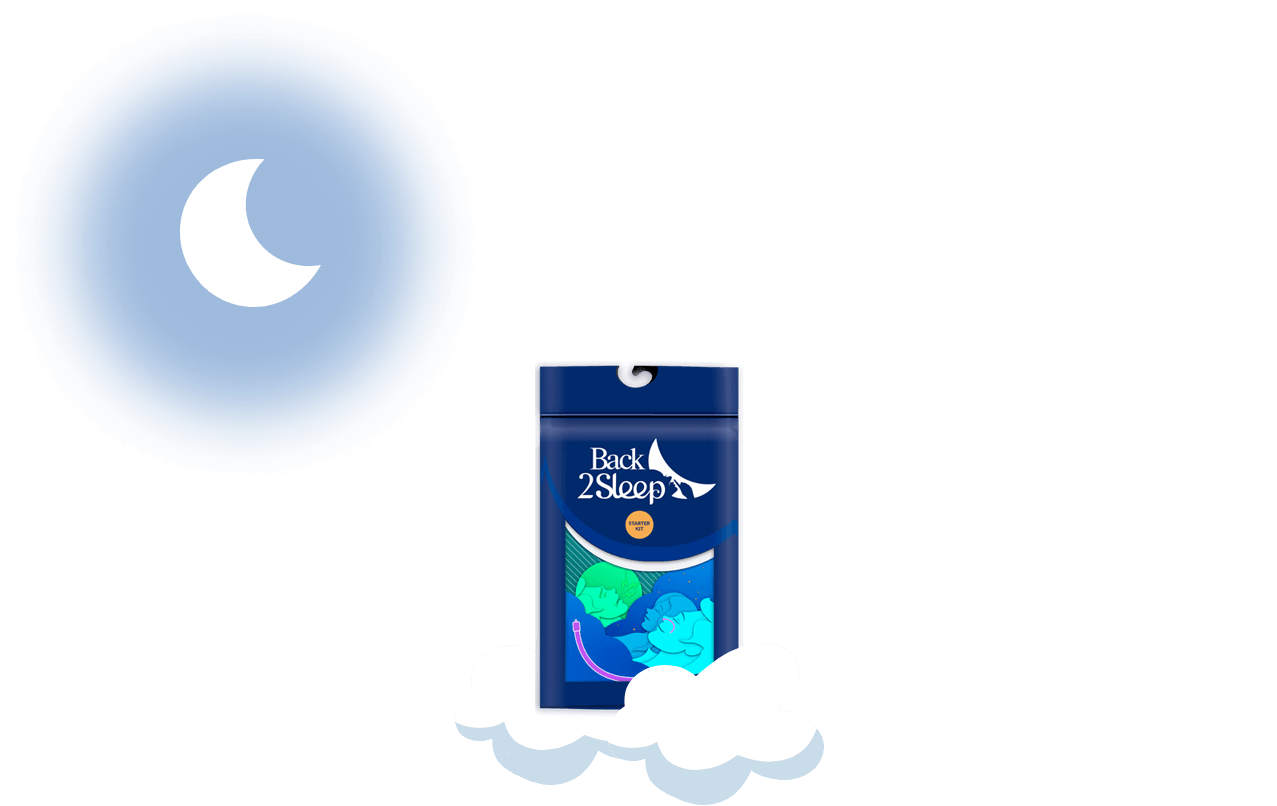
This is the one category where the anchorage question disappears. Back2Sleep is a CE-certified Class I soft silicone intranasal stent that sits in the nostril and keeps the nasal airway open during sleep. It needs no teeth, no ridge support and no dental impression, it does not interfere with a denture, and it can be worn with dentures in or out. No prescription is required, and the starter kit contains four sizes at around EUR 44.90.
Be clear about what the evidence says. The 101-patient study above tested a different nasopharyngeal stent, not Back2Sleep, so read it as category-level evidence: a modest average effect with a genuine responder rate, never a guarantee. Back2Sleep is intended for snoring and mild-to-moderate obstructive sleep apnoea, and trying it is how you find out whether you respond.
- The tongue device suits some people, but 63.6% had stopped using it by three weeks in the head-to-head trial.
- Nasal dilators showed no AHI benefit in the 2016 meta-analysis, while the nasopharyngeal stent study reported a modest reduction.
- Where the obstruction is retrolingual or multilevel, nasal-level devices are not the answer.
The European Pathway From Symptom to Device
In Europe, a snoring complaint with no teeth should start with a diagnosis, not a purchase. See a pneumologue or ORL specialist, a physician with a sleep-medicine qualification, and a prosthodontist for the dental side.
Testing usually means a polygraphie ventilatoire nocturne, or the equivalent home sleep apnoea test, worn overnight at home. It records airflow, breathing effort, snoring and the oxygen desaturation index (ODI). Full polysomnography is kept for unclear cases, and clinicians often add the Epworth Sleepiness Scale to grade daytime sleepiness.
What each country actually funds
In France, the OAM is first-line for moderate OSA with an IAH, the French term for AHI, between 15 and 30 per hour, and second-line where CPAP is refused or not tolerated. The French severity bands are mild 5-15, moderate 15-30 and severe 30 or more. Treatment by PPC or OAM needs a demande d'accord préalable from the Assurance Maladie medical service for patients aged 16 and over, using prescription model Réf. 634 Cnam through the amelipro teleservice.
In Germany, the UKPS is explicitly second-line. It is payable only "wenn die Überdrucktherapie mit einer Atemmaske nicht erfolgreich eingesetzt werden kann", and must be prescribed by a contracted physician with a sleep-medicine qualification, with dental billing through BEMA positions UP1 to UP6. A German reader cannot obtain a splint first, and cannot obtain one at all without anchor teeth.
- Get tested before you buy: edentulous patients carried two to three times the AHI of dentate patients (2024 review).
- France requires prior agreement (Réf. 634 Cnam via amelipro) for CPAP or splint therapy from age 16.
- Germany funds the splint only after positive airway pressure has failed, and only with load-bearing anchor teeth.
Safety First When Choosing an Anti-Snoring Device With Dentures
If you have no natural teeth and severe obstructive sleep apnoea, the next step is a sleep physician, not a mail-order purchase. At an AHI of 30 or above, the severe band in the French classification, no tooth-free consumer device on this page substitutes for positive airway pressure.
The risk profile also changes when a device leans on an unsupported alveolar ridge or a poorly retained denture instead of natural teeth. Load lands on soft tissue and bone rather than on a stable grip, an appliance can shift during the night, and any jaw-repositioning device should be checked by a dentist for temporomandibular joint (TMJ) strain. That is why self-fitted boil-and-bite products are the wrong tool here, and our comparison of boil-and-bite versus custom-fit appliances explains why.
- Severe OSA in an edentulous adult belongs with a sleep physician, not with a consumer device.
- Devices resting on a bare ridge or a loose denture carry a different risk profile from those anchored on teeth.
- Simple snoring and mild-to-moderate OSA are where tooth-free options such as a nasal stent reasonably belong.

What Back2Sleep Users Say
Frequently Asked Questions
Can you use an anti-snoring mouthpiece if you wear dentures?
Usually not. A mandibular advancement splint grips the upper and lower front teeth, and a removable denture cannot resist that nightly pull. France's Assurance Maladie lists complete edentulism as an absolute contraindication to the mandibular splint. Tooth-free routes such as a nasal stent, a tongue stabilising device, positional therapy or CPAP remain available.
Should I sleep with my dentures in or take them out if I have sleep apnoea?
Most sleep clinicians advise removing them. A 2021 randomised cross-over trial in SLEEP of 70 edentate elders found AHI essentially unchanged at 26.6 events per hour with dentures versus 25.6 without, but the respiratory arousal index was worse with them in, at 14.2 versus 11.9. Follow your own dentist's instruction if it differs.
How many teeth do you need for a mandibular advancement device?
There is no single European number, but France treats fewer than three or four residual teeth per hemi-arch as a relative contraindication to the orthèse d'avancée mandibulaire. German guidance requires sufficiently load-bearing teeth as anchorage. Strong upper and lower front teeth matter most, because the appliance pushes against them all night.
Can you get a sleep apnoea mouthguard if you have dental implants?
Sometimes. Where implants are osseointegrated and stable, a dental sleep specialist may build an appliance onto an implant-retained overdenture; clinical practice describes a minimum of two regular or four mini mandibular implants. A fixed full-arch bridge is a different case and needs a prosthodontist to assess the load before anything is made.
Why did my snoring get worse after I lost my teeth?
Tooth loss is linked to worse night-time breathing, not caused by the dentures themselves. In a 2022 PubMed Central study of 414 edentulous adults, mean AHI rose from 5.02 events per hour at six to nine months without teeth to 36.35 beyond fifteen months, then fell again after denture therapy.
Do tongue stabilising devices actually work or do people give up on them?
Both are true. In a 2009 randomised controlled trial published in SLEEP, treatment success was 45% for the tongue stabilising device against 68% for the mandibular splint, and 63.6% of patients had discontinued the tongue device by three weeks. It suits the people who tolerate it.
How do I get a home sleep apnoea test if I have no teeth?
Ask your GP for a referral to a pneumologue, ORL specialist or sleep-medicine physician. Being edentulous changes nothing about the test itself. A polygraphie ventilatoire nocturne or home sleep apnoea test records airflow, breathing effort, snoring and the oxygen desaturation index overnight at home. Full polysomnography is kept for unclear cases.
Is an orthèse d'avancée mandibulaire reimbursed if you wear a full denture?
No. In France the OAM requires prior agreement from the Assurance Maladie medical service, and complete edentulism is listed as an absolute contraindication, so the appliance is not prescribed in that situation. In Germany the splint is second-line after CPAP and requires sufficiently load-bearing teeth as anchorage.
Ready for quieter nights? Discover the Back2Sleep starter kit and find the right fit for you.
Not sure if you are at risk? Take our sleep risk screening to find out in just a few minutes.
Want to learn how it works? Explore the Back2Sleep nasal stent designed for comfortable, effective relief.