
Training Your Airway With Myofunctional Therapy Compared With Holding It Open With a Nightly Device

Myofunctional therapy vs anti-snoring device weighed on effort, time to effect and how long the result lasts
Three months of daily tongue exercises or a device that works from the first night, compared on real trial data, published adherence rates and European reimbursement rules.
Myofunctional Therapy vs Anti-Snoring Device Runs on Two Different Clocks
The real question behind myofunctional therapy vs anti-snoring device is whether you want to train your airway or hold it open. Myofunctional therapy is a structured programme of oropharyngeal exercises that retrains the tongue, soft palate and throat muscles over roughly three months. A nightly device changes the shape of your airway mechanically, from the first night you use it.
Both routes are aimed at primary snoring and mild-to-moderate obstructive sleep apnoea. They simply charge you in different currencies. If you want the exercise catalogue itself, we cover the tongue exercises for snoring with real trial evidence behind them in a separate guide. This page answers the question those guides skip, which is which route to start.
Here is the arithmetic almost nobody publishes. At the usual prescribed dose of 10 to 30 minutes a day, twelve weeks of orofacial myofunctional therapy (OMT) is around 90 consecutive practice sessions and 15 to 45 hours of effort before your first honest re-measurement. A device is one sizing session and one night.
- Exercises are a training programme measured in months. A device is a mechanical change measured in nights.
- Twelve weeks at 10 to 30 minutes daily is roughly 90 sessions before you can fairly judge the result.
- Neither approach is for severe sleep apnoea, and neither replaces a proper diagnosis.

What the Evidence Actually Shows in 2026
The science on myofunctional therapy has split into two generations that disagree. The older synthesis reported a large fall in the apnoea-hypopnoea index (AHI, written IAH in French). The newest synthesis found that fall is no longer statistically reliable, while the symptom benefits survived.
The optimistic generation is genuine. In the 2015 systematic review and meta-analysis by Camacho and colleagues in Sleep, adult AHI fell from 24.5 to 12.3 events per hour, snoring dropped from 14.05% to 3.87% of total sleep time, and Epworth Sleepiness Scale (ESS) scores fell from 14.8 to 8.2. The 2009 randomised trial by Guimarães and colleagues in the American Journal of Respiratory and Critical Care Medicine saw AHI drop from 22.4 to 13.7 events per hour in 31 patients doing about 30 minutes daily for three months, with no significant change in the control group.
Then the certainty grading arrived. The 2020 Cochrane review of 9 randomised trials and 347 participants rated the sleepiness benefit at moderate certainty, at -4.52 Epworth points versus sham, but graded the -13.20 events per hour AHI result as low-certainty evidence. Subjective snoring intensity fell by 1.9 points, again at moderate certainty. The 2025 network meta-analysis in the Journal of Evidence-Based Dental Practice, covering 15 randomised trials and 473 adults, then found the AHI change of -8.73 per hour was not statistically significant. Epworth still improved by -3.54 points and the Pittsburgh Sleep Quality Index (PSQI) by -2.24 points.
- The surviving claims for exercises are less sleepiness, better sleep quality and quieter snoring.
- The objective severity claim has been downgraded twice since 2015, not confirmed.
- If you want a measurable AHI change from exercises, plan for more than 30 minutes daily.
Roughly Nine in Ten People Never Finish the Programme
Adherence is the number that decides this comparison, and no popular exercise page prints it. O'Connor-Reina and colleagues state it plainly in the Journal of Clinical Medicine in 2021: myofunctional therapy has low adherence, only around 10% in most studies.
That single sentence reframes every efficacy figure above. Those results come from the minority who completed a full programme. The published dropout rate means the realistic question is not whether it works, but whether you will still be doing it in week nine. The same 2021 paper reported that telemedicine and app-delivered myofunctional therapy achieved good adherence, and that its effect on AHI correlated with measured tongue strength.
Poor treatment adherence is not a character flaw. A daily 20-minute set of mouth exercises for snoring competes with work, children and fatigue, and it produces no feedback for weeks. A device produces feedback the same night, from the person sleeping beside you.
- Published adherence to myofunctional therapy sits near 10%, per the 2021 Journal of Clinical Medicine paper.
- Efficacy figures describe completers, not the average person who starts.
- App-supported or clinician-supervised delivery is the documented way to improve adherence.
What Happens to Your Snoring If You Stop the Exercises
Trained muscles detrain, and no competitor page tells you what that means for snoring. The closest published answer sits inside the 2015 Camacho meta-analysis in Sleep. In its paediatric follow-up, 11 children who kept doing therapy stayed effectively cured at an AHI of 0.5 events per hour, while 13 who stopped relapsed to 5.3 events per hour at four years.
That is children, not adults, and a small sample. It is still the only durability signal in the evidence reviewed here, and it points one way: benefit appears tied to continued practice. No trial cited here sets an adult maintenance dose.
A mechanical device has the mirror-image property. Its effect does not decay, because there is nothing to detrain, but it also carries nothing over. It works on the nights you wear it and not on the nights you skip. Both approaches are therefore ongoing commitments, one measured in daily minutes and one in nightly use.
- The only published durability data suggests relapse after stopping, in children followed for four years.
- No validated adult maintenance dose exists, so treat exercises as a permanent habit rather than a course.
- A device has no training curve and no detraining curve, only nightly use.
Why a Perfect Twelve-Week Programme Can Still Change Nothing
Myofunctional therapy trains the genioglossus muscle, the soft palate and tensor veli palatini, and the pharyngeal walls. That anatomy governs retroglossal and retropalatal collapse, tongue posture and mouth breathing. It is the right target for a large share of snorers, and it is also the reason a diligent programme sometimes returns nothing.
No amount of tongue training can open a collapsing nasal valve, shrink turbinate hypertrophy or straighten a deviated septum. If your obstruction sits in the nose, you can complete 90 flawless sessions and still snore identically on night 91. Ankyloglossia, or tongue tie, is another blocker worth checking first, since a restricted tongue may need a frenectomy assessment before exercises can work.
Find out which type you are before spending the three months. A home sleep apnoea test or polygraphie ventilatoire shows whether this is primary snoring, upper airway resistance syndrome (UARS) or genuine mild-to-moderate obstructive sleep apnoea. An ENT examination locates the obstruction, and drug-induced sleep endoscopy (DISE) is used in selected cases to watch the collapse directly.
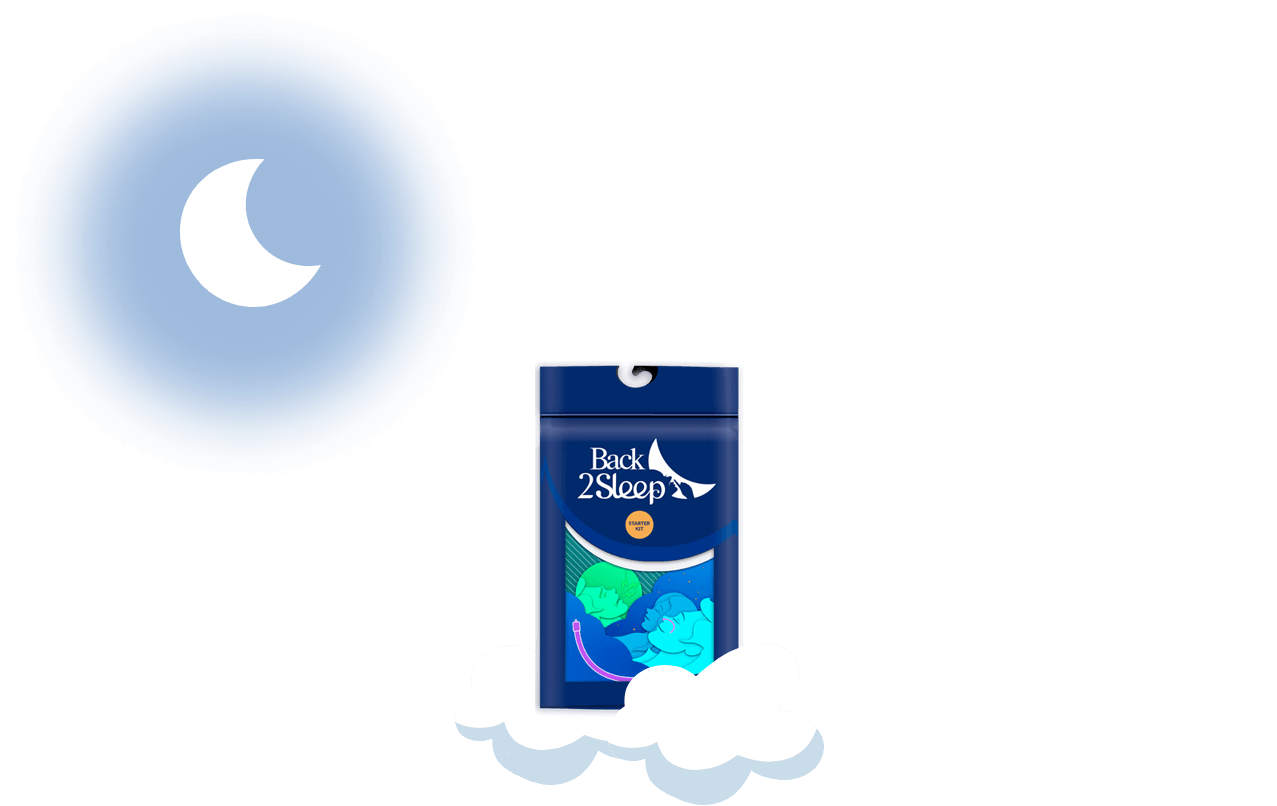
This is where a nasal-route device and an exercise programme stop being rivals. The Back2Sleep nasal stent is a soft silicone tube, CE-certified as a Class I device, that physically holds the nasal airway open through the night, including the segment exercises anatomically cannot reach. For what that feels like in practice, read what the first night with a nasal stent is really like.
- Exercises reach the tongue base and palate. They cannot reach the nasal valve, turbinates or septum.
- Nasal-pattern snorers are the group most likely to finish a programme with no result.
- Get a sleep test and an airway assessment before committing three months of daily practice.
Myofunctional Therapy vs Anti-Snoring Device Side by Side
The only near head-to-head trial in this space favours the mechanical option on speed. In a 2024 pilot randomised clinical trial published in JAMA Otolaryngology-Head & Neck Surgery, 42 completing patient and partner pairs were assessed after four weeks. Partner-rated snoring response was reached by 21 of 23 pairs, or 91%, with a mandibular advancement device, versus 11 of 19 pairs, or 58%, with combined airway and positional therapy. That is a 33-point gap and a number needed to treat of three.
| Approach | Time to first effect | Daily effort | Best-supported claim, with source and year | Long-term downside |
|---|---|---|---|---|
| Myofunctional therapy (oropharyngeal exercises) | About 3 months | 10 to 30 min awake practice | Less sleepiness and quieter snoring, at moderate certainty (Cochrane 2020) | No physical side effects reported, but adherence near 10% (Journal of Clinical Medicine 2021) |
| Mandibular advancement splint (MAS) | First nights, then stepwise advancement titration | Nightly wear | 91% partner-rated response at 4 weeks (JAMA Otolaryngology-Head & Neck Surgery 2024) | Time-related dentoskeletal and occlusal change (European Journal of Orthodontics), so ongoing dental review |
| Daytime tongue neuromuscular electrical stimulation (NMES) | About 6 weeks | 20 min awake, once daily | 95% of 70 patients cut objective snoring time, by 48% on average (Sleep and Breathing 2021) | EU MDR indication stops at primary snoring and mild OSA |
| Nasal stent or nasal dilator | First night | Insert at bedtime | Keeps the nasal airway open during sleep, CE-certified Class I device | Needs correct sizing, and addresses the nasal route only |
A tongue-retaining device (TRD) is a further oral-appliance category that holds the tongue forward instead of advancing the jaw. No trial cited here tested one, so it stays out of the table rather than being given numbers it has not earned.
Awake training devices sit between the two camps. In the 2021 study by Kotecha and colleagues in Sleep and Breathing, 20 minutes of daytime tongue stimulation once daily for six weeks reduced objective snoring time in 95% of 70 patients, by 48% on average. In the mild-OSA subgroup, AHI fell from 9.8 to 4.7 events per hour and the oxygen desaturation index (ODI) from 7.8 to 4.3. A 2021 multicentre study in the Journal of Clinical Medicine reported a 41% mean fall in objective snoring across 115 completing patients.
The side-effect ledger is the one column where exercises win outright. The European Journal of Orthodontics documents time-related dentoskeletal and occlusal change with mandibular splints, which is why ongoing dental monitoring belongs in that pathway. Exercises produce no such change, and a nasal stent has no occlusal consequence at all.
- On four-week snoring response, the mechanical route beat the training route in the only pilot trial available.
- Splints carry a documented dental cost over years. Exercises and nasal devices do not.
- Speed and durability are separate questions, and no single option wins both.
The European Pathway Inverts the Cost Argument
In France the exercises are a reimbursed medical act while the splint is the item needing prior authorisation, which reverses what most English-language pages assume. The rules then differ sharply by country, so the same decision has three different answers.
| Country | Exercise route | Device route |
|---|---|---|
| France | Rééducation myofonctionnelle delivered by an orthophoniste, fees set by the NGAP nomenclature, reimbursed at 60% by Assurance Maladie with the ticket modérateur usually covered by a mutuelle. Without a prescription there is no reimbursement at all. | An orthèse d'avancée mandibulaire (OAM) must be listed on the LPP and needs accord préalable from the CPAM, granted for confirmed sleep apnoea-hypopnoea syndrome with daytime symptoms. Simple snoring does not qualify. |
| Germany | The equivalent clinician is a Logopäde. Myofunctional therapist is not a protected or reimbursable title in most EU member states, so book by the national professional title. | The Unterkieferprotrusionsschiene (UKPS) became a statutory GKV dental benefit on 1 January 2022, after the G-BA decision of 20 November 2020, and only where positive airway pressure therapy cannot be used successfully. |
| United Kingdom | NICE carries no comparable recommendation for myofunctional therapy, so it sits outside the NHS pathway. | NICE guideline NG202 (2021) recommends a customised or semi-customised mandibular advancement splint across mild, moderate and severe symptomatic OSAHS where CPAP is declined or not tolerated. |
Two practical warnings follow. NICE flags that semi-customised splints may be inappropriate for people with active periodontal disease or untreated dental decay. And the standard instruction to find a certified myofunctional therapist is close to unactionable in Europe, because that title is neither protected nor reimbursable in most member states. The clinician you actually book is an orthophoniste, a logopedist or a Logopäde.
Terminology matters when you search, too. AHI is IAH in French, and the splint is an OAM in France, a UKPS in Germany and a MAS in the UK. Under the EU MDR, daytime tongue neurostimulation is certified with an indication limited to primary snoring and mild OSA, which is a useful ceiling statement for every training-based approach.
- In France exercises can be 60% reimbursed with a prescription, while the splint needs prior authorisation.
- In Germany a splint on the Kasse requires documented positive airway pressure failure first.
- In the UK the splint sits inside the NICE pathway and the exercises do not.
Myofunctional Therapy or a Nightly Device, Decided in Four Steps
1Get the diagnosis before the plan
Book a home sleep apnoea test or polygraphie ventilatoire with a prescribing physician. Snoring, UARS, mild-to-moderate OSA and severe OSA are different problems with different answers, and self-treating without that number is how three months get wasted.
2Locate the obstruction, then pick the tool
If your collapse is retroglossal or retropalatal, exercises target it directly. If it is nasal valve collapse or turbinate hypertrophy, they cannot reach it, and a nasal-route device or ENT treatment is the logical first move.
3Use a device as bridge therapy while you train
Nothing stops you doing both. The 2025 network meta-analysis found the most pronounced AHI reduction when therapy was combined with positive airway pressure, and that combination evidence covers positive airway pressure specifically, not over-the-counter devices. What a device buys you is liveable nights while the training curve runs.
4Plan for the version of you who lapses
Given adherence near 10%, decide in advance what happens if daily practice stops. A modality whose effect does not depend on a daily habit is the honest fallback, alongside positional therapy if your snoring is worse on your back.
- Diagnose first, locate the obstruction second, then choose the tool that matches it.
- Combining a device with training is a reasonable plan, and usually the fastest route to quiet nights.
- Choose the option you will still be using in six months, not the one that sounds most virtuous.

What Back2Sleep Users Say
Frequently Asked Questions
Can tongue exercises replace my anti-snoring device?
Sometimes, but not reliably. The 2020 Cochrane review found exercises reduce sleepiness and snoring intensity, while the 2025 network meta-analysis found no significant change in the apnoea-hypopnoea index. If your obstruction is nasal, exercises cannot reach it. Many people use both, with the device covering nights while training continues.
How long do mouth and throat exercises take to stop snoring?
Plan on three months. The 2009 Guimarães trial in the American Journal of Respiratory and Critical Care Medicine used about 30 minutes daily for three months before re-measuring, and the 2025 network meta-analysis linked more than 30 minutes daily to AHI change. That is roughly 90 practice sessions. A device works from the first night.
Do you have to do myofunctional therapy forever, or can you stop once it works?
No adult maintenance dose has been established. The clearest signal comes from the 2015 Camacho meta-analysis in Sleep, where 11 children who continued therapy stayed at an AHI of 0.5 events per hour while 13 who stopped relapsed to 5.3 at four years. Assume ongoing practice.
Does myofunctional therapy actually lower AHI or does it just make you feel less sleepy?
Current evidence supports the symptom benefit more than the severity benefit. The 2025 network meta-analysis in the Journal of Evidence-Based Dental Practice reported Epworth down 3.54 points and Pittsburgh Sleep Quality Index down 2.24 points, but the AHI change of 8.73 per hour was not statistically significant.
Is myofunctional therapy better than a mandibular advancement device for mild sleep apnoea?
On four-week snoring response, no. The 2024 pilot trial in JAMA Otolaryngology-Head and Neck Surgery reported 91% partner-rated response with a mandibular advancement device versus 58% with combined airway and positional therapy. Exercises win on side effects, since splints carry documented dentoskeletal and occlusal change over years.
Can I do myofunctional exercises and wear an anti-snoring device at the same time?
Yes, and combining is often the better plan. The 2025 network meta-analysis found the most pronounced AHI reduction when therapy was combined with positive airway pressure. A device handles tonight while the training curve runs, which matters most for the partner who is not waiting three months.
Why do throat exercises not work for some snorers?
Because they train the wrong part of the airway for that person. Exercises strengthen the genioglossus, soft palate and pharyngeal walls. They cannot open a collapsing nasal valve, shrink enlarged turbinates or correct a deviated septum, so nasal-pattern snorers can finish a perfect programme with no change.
Is myofunctional therapy reimbursed by health insurance in France, Germany or the UK?
In France, sessions with an orthophoniste are reimbursed at 60% by Assurance Maladie, but only with a prescription, and a mutuelle usually covers the ticket modérateur. In Germany the equivalent clinician is a Logopäde, though myofunctional therapist is not a protected or reimbursable title in most EU states. NICE gives no comparable UK recommendation.
Do I need a home sleep apnoea test before choosing a treatment?
Yes. A home sleep apnoea test, called polygraphie ventilatoire in France, separates simple snoring from upper airway resistance syndrome and from mild-to-moderate or severe sleep apnoea. EU reimbursement pathways generally require it before a device is authorised, and it stops you spending three months on the wrong target.
Ready for quieter nights? Discover the Back2Sleep starter kit and find the right fit for you.
Not sure if you are at risk? Take our sleep risk screening to find out in just a few minutes.
Want to learn how it works? Explore the Back2Sleep nasal stent designed for comfortable, effective relief.